
Integrated Edge device and completion of advanced functionalities
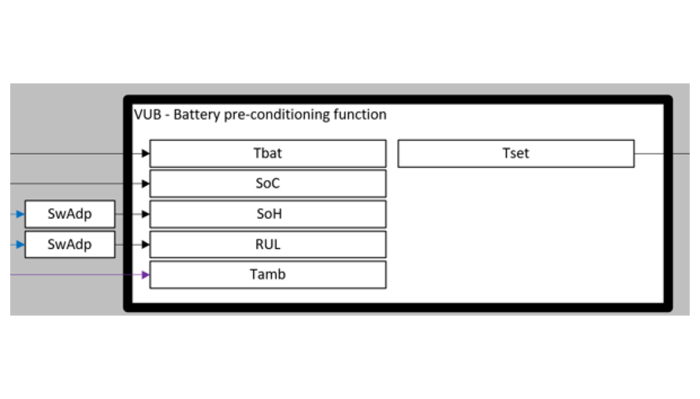
InnoBMS is proud to share that with the completion of D3.1, the project has completed the development, compilation, integration and testing of all the InnoBMS software, hereby achieving MS7 of the project. Two complementary software streams have been developed within the InnoBMS project: advanced functionality software for the embedded Edge system; and core software for the sub-Battery Management System (sBMS). All The advanced functionalities developed within the project have been implemented as edge-executable software models, including FMU-based implementations compliant with the Functional Mock-up Interface (FMI) standard. These contributions include physics-based models, data-driven algorithms, and control strategies, developed in accordance with the computational and integration constraints of the InnoBMS Edge platform. To ensure interoperability among the functional components developed by the project partners, the InnoBMS Edge ECU software architecture provides a harmonised framework for software interfaces and integration activities. It also supports the communication infrastructure required for data exchange among the Edge ECU, Vehicle Control Unit (VCU), and Battery Management System (BMS).
The sub-Battery Management System (sBMS) provides the core battery-management functionality and interfaces with the other system units, including the Edge ECU and VCU. Its main functions include the acquisition and management of battery sensor data, communication of cell-level information, and support for battery-system safety and cybersecurity. The sBMS also directly controls the high-voltage (HV) contactors to ensure safe battery-pack operation.
Overall, Milestone 7 confirms that the final InnoBMS software components have been compiled, integrated, and tested, providing the software baseline required for the subsequent system-level validation and demonstration activities, details can be found in D3.1 which is a public deliverable.